i-Mirage surrounds your real infrastructure with high-fidelity interactive decoys. Across IT, OT/ICS, cloud, and telecom signalling — the moment an attacker strikes a decoy, they are caught.
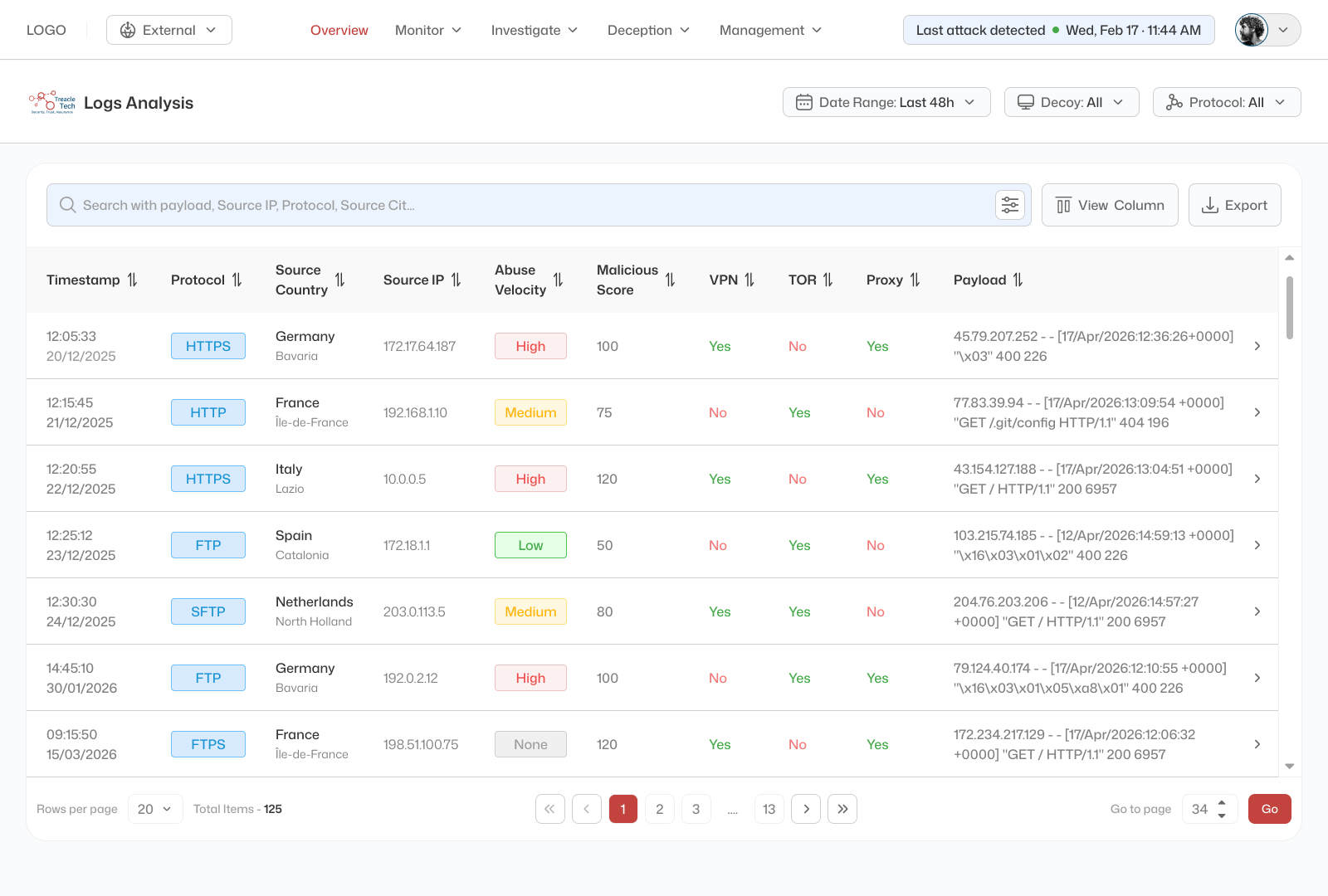
Industry avg. detection time vs. instantaneous alerts with i-Mirage
Reflex response speed to isolate target at machine speed
False positives. Only attackers touch deception assets
Native domains: IT, OT/ICS, Cloud, and Telecom signalling
Leaves critical on-prem, OT, and telecom signallings blind and exposed.
Guesses intent based on messy log traffic, generating endless alerts.
Security teams spend hundreds of hours filtering white noise and false positives.
Must constantly be retrained to your environment or it becomes useless.
Universal coverage across every operational domain you run natively.
The alert is generated because a decoy was touched. It's proof of malicious intent.
Employees have no business interacting with fake systems. No noise.
Intelligent layout placement forces lateral movements straight into traps.
Deploy decoys native to each environment — not a generic honeypot behind one infrastructure it doesn't understand.

Active Directory deception, fake credentials injected dynamically into memory, and realistic file shares.

Deception native to power, utility, and rail grids. Simulated SCADA, PLC registers, and HMI structures.

AWS, Azure, and GCP native honey-tokens, simulated containers, and decoy serverless functions.

Simulated core infrastructure detecting signaling attacks on SS7, Diameter, and GTP protocols.
Five steps, running continuously, with no added headcount and no production risk.

Decoys are positioned and repositioned dynamically across the estate.
01
Every interaction is scored for malice and intent — not just logged.
02
Attacker lifecycle is mapped automatically against MITRE ATT&CK.
03
Verified signals push straight into SIEM / SOAR / EDR — no triage backlog.
04
Daily, automated, board-ready reporting — no manual write-up.
05Machine-speed reconnaissance and lateral movement compromise window defenders before they can react. Deception doesn't try to run faster than the attacker — it sits waiting at every possible pivot point.
Talk to us about your threat modelIsolate malicious entities at hardware speed.
Genuine users don't trigger deceptive triggers.
Whether the intrusion is a long human-led state campaign or an automated worm, the physical interaction of touching a decoy is a constant. We break the execution loop immediately.

Securing global enterprises, financial institutions, and critical infrastructure against advanced modern threats.








Real interceptions and real deployments — not hypothetical scenarios.
"An attacker used a stolen domain admin credential to query AD. Our AD deception modules dynamically injected a deceptive credential which pointed directly to a simulated crown-jewel file share. Attacker immediately attempted connection and was instantly locked out before writing any persistence."
Founded in 2021 as a deep-tech spin-out from IIT Kanpur, designed to turn the tables on elite hostile threat groups.

Leading researcher in dynamic threat modeling and system virtualisation at IIT.

Architect of the high-fidelity emulation engine and air-gapped system isolation.

Expert in active directory, infrastructure and telecom signalling vector traps.

Former national defensive cyber security operator directing regional rollouts.
Backed by a distinguished national defense and industrial security advisory board with operations spans in financial centers and critical infrastructure nodes.
Expert analysis, threat intelligence reports, and deception technology deep-dives.

A deep dive into the tactics used by sophisticated actors and how active deception environments can outsmart them.
Read more
Practical strategies for reducing noise and increasing signal-to-noise ratio in your security operations center.
Read more
An architectural comparison between legacy decoy systems and modern active deception platforms.
Read moreDeployed across leading retail banks, national electricity grids, and defense networks, i-Mirage supplies the definitive physical evidence path required by modern cyber threat reporting directives.


Zero downtime deployment. Simple non-intrusive implementation.
Agentless in OT/ICS. Absolutely zero host risk to core process plants.
Full audit trail per incident, proving intent and exfiltration scope.
MITRE ATT&CK mapped evidence ready for defense boards.
Board-ready automated incident forensics, generated within minutes.
Everything you need to know about i-Mirage active deception technology and how we proactively safeguard your enterprise from lateral cyber threats.
Active deception technology goes beyond traditional honeypots by deploying dynamic, high-fidelity decoys that mimic real assets across your entire infrastructure. Unlike static honeypots, i-Mirage decoys adapt to your environment, are repositioned automatically, and generate zero false positives — every alert represents a confirmed threat interaction.
i-Mirage can be fully deployed in under 48 hours across enterprise environments. Our agentless architecture means no software installation on endpoints — decoys are spun up directly within your network segments, covering IT, OT, cloud, and identity layers from day one.
Active deception technology goes beyond traditional honeypots by deploying dynamic, high-fidelity decoys that mimic real assets across your entire infrastructure. Unlike static honeypots, i-Mirage decoys adapt to your environment, are repositioned automatically, and generate zero false positives — every alert represents a confirmed threat interaction.
Active deception technology goes beyond traditional honeypots by deploying dynamic, high-fidelity decoys that mimic real assets across your entire infrastructure. Unlike static honeypots, i-Mirage decoys adapt to your environment, are repositioned automatically, and generate zero false positives — every alert represents a confirmed threat interaction.
Active deception technology goes beyond traditional honeypots by deploying dynamic, high-fidelity decoys that mimic real assets across your entire infrastructure. Unlike static honeypots, i-Mirage decoys adapt to your environment, are repositioned automatically, and generate zero false positives — every alert represents a confirmed threat interaction.
Request a scoped, risk-free proof of value pilot. Catch unauthorized lateral movement in real-time.